Thursday, June 21, 2012

D-Day: Special School Edition


The cover of Livingbattlefield's The Americans on D-Day, school edition


Our mission at Livingbattlefield is to produce educational documentary films which help young citizens connect with our nation's glorious history. Our current World War II series, The American Road to Victory, has aired more than 3,000 times on PBS stations nationwide. The three films follow American soldiers from the blood-soaked beaches of D-Day, through Operation Market Garden in Holland, to the Battle of The Bulge in Belgium. Unique in presentation and content, the films take viewers to the exact locations of battle and were made to engage students.

Teacher, Kiernan H. Butz says, "As a lifelong historian and avid student of World War Two, I find the realism and historical accuracy of this series remarkable. These films are a fantastic classroom aid.
The first film in the trilogy, The Americans on D-Day, has particular significance in the high school classroom and has been welcomed by many educators. Described by the American Legion as “the next best thing to being there,” our D-Day film gives students a real time look at the events of that momentous day and the impact it made on world history.
We are currently seeking sponsors who will help ensure that every high school teacher and student has access to this important learning aid.
Each special "school edition" of the film will be accompanied by a lesson plan, map, lifetime public performance rights, and will be branded as donated by our sponsors.
We propose to provide 2 films and associated learning materials to each high school. The cost will be $50 per high school, and we are seeking sponsors for units of 20. Livingbattlefield will handle all fulfillment.
Help us to ensure that the achievements of the "Greatest Generation" are never consigned to the dusty archives of ancient history; rather, brought to life in classrooms for our students through your sponsorship.

As a secondary school history teacher for 23 years I've used a number of documentaries on WWII.  I've shown none that are more accessible to students (or general viewers) than your films.  The overall concept and general approach of the films and Ellwood's engaging narration make each of these complex engagements understandable for the learner.   --Doug Barber Centerville,OH

Monday, June 4, 2012

June 4th 1944

U.S soldiers pass the Coliseum.


Rome became the first Axis capitol to be captured by the Allies, when advance units of the 5th US Army entered the city limits.

On 4th June, a six-man patrol from the 3rd Platoon, 88th Reconnaissance Troop, entered Rome at 0730 hours on Highway 6. This patrol later was credited, officially, by Fifth Army as being the first Allied troop element to enter Rome.

The 3rd Platoon had fought its way to within two miles of Rome. There it halted and the patrol was dispatched to reconnoiter the road ahead. Shortly before 0730 hours the lone jeep, moving forward cautiously, passed the "Roma" city limits sign and proceeded for about a kilometer and a half to a small railroad station from which point a Kraut machine gun opened up on the patrol.

Sensing the immediate danger and because their orders called for it, the patrol retraced its route and Staff Sgt. John T. Reilley of Watervliet, N.Y., reported to his platoon leader that he'd been in Rome. Cpl. Cassie W. Kuemin of Detroit, Mich.; T-5 Roy T. Cutler of Moweaqua, Ill.; Pfc. John E. Cottrell of Rochester, N.Y.; Pfc. Matthew J. Fitzpatrick of Brooklyn, N.Y.; and Pfc. Michael J. Regan of North Bellmore, Long Island, N.Y.; confirmed Reilley's report and "da##ed the Kraut machine gun which had spoiled everything."
Quoted from 88th Infantry Division history.


U-505 soon after capture.
 
                           The U-505 Captured, June 4, 1944


Today in 1944, Unterseeboot 505, a German Type 9C submarine, was captured by the US Navy. This marked the first time since 1815 that an American crew had captured an enemy at sea and was the only time during World War Two that the US Navy captured a submarine intact.

The U-505 was something of an unlucky ship. Since her commissioning in 1941, she had had several different captains, one of whom committed suicide while the ship was under depth charge attack in October, 1943. To make matters worse, by the middle of 1944, the “good old days” of the German U-boat fleet were over. American industrial might and the onset of new technologies had turned the Battle of the Atlantic against the once-feared subs, so much so that a crew leaving on patrol had as much chance of dying at sea as returning. But a well-trained crew and a U-boat in top mechanical form could still be a deadly combination. With this in mind, the Allies created task forces centered around escort carriers whose sole mission was to hunt down and destroy German subs.

One such force was Task Group 22.3 comprised of the escort carrier USS Guadalcanal and five destroyer escorts. The group had been steaming off the western coast of Africa, an area that naval intelligence indicated was a recent hotbed of U-boat activity. While Allied codebreakers had broken the German naval code and knew of general movement orders, the exact locations of U-boats was encrypted before being re-encrypted by the Enigma machines and were, thus, unreadable. The task group had found nothing after two weeks in the area and on the morning of June 4th, set a course for Casablanca.

As soon as the group changed course, one of the destroyer escorts detected a U-boat only 800 yards away. The Guadalcanal immediately changed course to give the smaller ships room to maneuver and the fight began. Soon, planes from the carrier spotted the sub and fired into the water to mark her position. Depth charges followed. An oil slick formed and five minutes later, U-505 broke the surface. Her diesel engines were the only things still working.

The escorts immediately opened fire on the sub, which was still running at seven knots and was turning towards a nearby destroyer. That destroyer, the Chatelain, fired a torpedo at the sub in defense, but missed. It became obvious that no one was steering the U-boat as she continued to turn in a tight circle. Crewmen from the sub were in the water and were picked up by the escorts while a launch was sent to the sub with a boarding party.


Lieutenant Albert David was the first man to climb aboard the pitching deck of the sub. He led his eight-man team down the conning tower hatch despite the fact that he did not know what awaited him below. Fortunately, the entire crew had abandoned ship. Furthermore, the had left so fast that they had not completed the actions necessary to completely scuttle the vessel. While she was slowly sinking by the stern and her rudder was jammed over hard, the American prize crew was able to close the valves and stop the sea from rushing in. Only one man was killed in the action, a German sailor who had run out on deck when the U-505 surfaced and had been hit by machine gun fire.

Flying a large American flag from the conning tower, U-505 was towed to Port Royal Bay, Bermuda, where she was kept in secrecy for the rest of the war. Her code books were valuable because they allowed the Allies to break the super-secret location codes that were used in addition to the regular naval Enigma codes. Since the German Admiralty thought the sub lost at sea and not captured, they never changed the codes.

Lt. Albert David received the Congressional Medal of Honor for his role in saving the submarine from sinking; two of the sailors in his boarding party received the Navy Cross. The 58 surviving crewman of the U-505 spent the rest of war as POWs in the United States.

Matt Dattilo


Thursday, May 17, 2012

'Over There'


Livingbattlefield is raising funds for its new series of documentary programs, Over There: Doughboys in the Great War, which has already been picked up by American Public Television for broadcast.

Doughboys will follow in the tradition of our ground-breaking World War II series for public television, The American Road to Victory. We've just gotten the latest broadcast numbers for "Road," and the series has (or will soon be) aired in more than 90 percent of the PBS market!
We'd like to recruit some of our fans to help get "Doughboys" broadcast in 2014 (the 100th anniversary of World War I). We're not asking for donations -- we're asking you to become part of our sales force by offering a unique product to friends, relatives and fellow history aficionados.

Magnetic, embossed wallet with challenge coin.
This is it! Our special collector's edition of The American Road to Victory! Without leaving home -- or the country -- people can enjoy three battlefield tours led by our stalwart guide and military historian, Captain (honorary) Ellwood von Seibold. Riding in his 1943 Dodge command car, Ellwood takes viewers across the terrain of Europe, explaining the hardships and sacrifices of our American troops in a way that only he can -- from foxhole-level, in three highly entertaining and informative programs: The Americans on D-Day, The Americans on Hell's Highway, and The Americans in the Bulge.

Recycled packaging and cork DVD hubs

Packaged in an elegant casing, the DVD trilogy is accompanied by a detailed campaign map and an impressive challenge coin, stamped by The North West Territorial Mint (makers of America's highest military award, the Medal of Honor).

This unique challenge coin was designed in conjunction with our partners, the National Infantry Foundation.
1.75" brass Challenge Coin, made in the USA

Our new collector's edition will be launched on June 1 at a price of $79.95. The "Road to Victory" series has been enjoyed by the viewing public in more than 1,300 broadcasts across America (another 1,600 broadcasts are scheduled for this year).

Now people all over America with an interest in World War II will be able to purchase our highly collectible special edition of The American Road to Victory, for themselves or as memorable gifts to others who value the legacy of our "Greatest Generation."

Here's what retired Marine Captain Dale Dye, military advisor for "Saving Private Ryan" and "Band of Brothers,"and the presenter for Doughboys, has to say about our "Road to Victory" series:

"Everyone I’ve encountered who has seen 'The American Road to Victory' - from young students to historians and nit-picking military enthusiasts - has told me it’s the best and most inspiring view of World War II in the European Theater of Operation they’ve ever seen."


Now we want to show America what it was like to fight in the trenches of World War I -- from foxhole-level again -- what it was like to plunge into "no man's land," stumble through clouds of mustard gas, struggle to sleep in the midst of deafening artillery barrages that went for hours on end.

What was it like to fight nearly a century ago, in the "war to end all wars?" Our Doughboys series will be "the next best thing to being there," as The American Legion said of our Americans on D-Day program.

History lovers unite! Join Livingbattlefield in creating our epic 4-part Doughboys documentary series for public television. If you would like to become a member of our national sales force, please contact our chief executive officer, Heidi Lanni: heidi@livingbattlefield.org.

Tuesday, April 24, 2012

Hollywood's premier military adviser to present WWI miniseries.

Livingbattlefield are delighted to confirm Dale Dye USMC (retired) as the presenter and military adviser for our new 4 part mini series on WWI, Over There, Doughboys in the Great War.
Livingbattlefield's CEO Heidi Lanni, who is also the wife of the writer/director, said "having Dale on-board is fantastic; not only for his amazing skills as a presenter, but also for his vast military knowledge. Now we can really start to gather momentum with this important project."


Captain Dale Dye.


"As Hollywood’s most recognized and experienced Military Advisor to film and TV productions, I get dozens of proposals yearly to either help in production or serve as host to war-themed documentaries.  Most of these are half-baked, down and dirty, fast and fuzzy compilations of talking heads and stock footage with little to contribute either to education or entertainment.  That’s the reason I jumped at the chance to work with documentarian and filmmaker Richard Lanni and his staff.  Richard combines an inspirational passion for his projects with an extraordinary depth of research that makes his treatment of military themes both valuable additions to the historical record and sprightly, engaging entertainments.
            A sterling example of his expertise is the current multi-part treatment of the United States Army experience in World War II in the European Theater of Operations titled “The American Road to Victory.”  It was both a distinct honor and a professional challenge to advise Richard Lanni on this impressive project and contribute whatever he needed to bring the work the high-profile it so richly deserves.  The result of his hard work and dogged dedication to the subject matter has turned out to be one of the most incisive and fascinating looks at World War II from the perspective of the average soldier who faced and defeated Nazi Germany on the European continent.  Everyone I’ve encountered who has seen “The American Road to Victory”  - from young students to historians and nit-picking military enthusiasts - has told me it’s the best and most inspiring view of World War II in the ETO they’ve ever seen.
            And that’s the reason I’m so proud to join Richard Lanni in his next project which will take us back a bit in military history to World War I.  I’m privileged to serve as presenter as well as advisor to “Over There:  Doughboys in the Great War.”  This will be an in-depth, intriguing and inspiring look at one of the most pivotal and costly conflicts in the history of mankind.  Richard and I will answer many of the nagging questions about that seminal war, examine the leaps in technology involved such as tanks and aircraft, and give our audiences a feel for the brutal, dehumanizing experience of static war in muddy, bloody trenches.  I’m excited to be back on the road with Richard Lanni and his staff of talented filmmakers and I’ve got my window seat reserved as we take our audiences back in time to The Great War."    

The team  have also been bolstered by the addition of author and historian, John C. McManus Ph.D, who will ensure the historical accuracy of the mini-series.


Tuesday, March 27, 2012

The American Road to Victory finds a home Fort Benning, GA


For Immediate Release
National memorial joins forces with  filmmakers
The National Infantry Museum Foundation at Fort Benning, Ga., home of a powerful tribute to U.S. infantrymen through the ages, and Livingbattlefield,  producers of the groundbreaking World War II film trilogy, The American Road to Victory, have partnered to further their shared mission of keeping military history alive.

The museum, located outside one of the Army's major recruit training facilities, has become a sponsor of the World War II film trilogy, which has aired more than 1,200 times on PBS affiliates nationwide.

"We knew, after screening one of the films in our theater on Veterans Day, that we wanted to be a part of this," said foundation president Ben Williams. "The films represent a great example of everything we stand for -- real history for families. "

"This is such an honor for us", said Heidi Lanni, Livingbattlefield’s CEO and wife of series director Richard Lanni. "Receiving support from such an important national institution tells us that our decision to work outside the box of traditional war documentaries -- to look at war from a foxhole level -- was the right one to make.”
Foundation President, Ben Williams & film director Lanni

The films, which will continue to air nationally, take the form of battlefield tours. Shot in real time, in the exact locations, they are underpinned by powerful veterans' testimonies, graphics and re-enactments. Presenting the series is colorful front man, Ellwood von Seibold, one of Europe’s leading battlefield guides and an honorary officer in the U.S. Army.

Series viewers get the opportunity to travel along with Ellwood in his 1943 Dodge command car from the blood-soaked beaches of Normandy, through the killing fields of Holland, to the freezing forests of the Bulge.

Many veterans featured in the series passed through Fort Benning during WWII.

-30-

Media contacts:

Ben Williams: bwilliams@nationalinfantryfoundation.org
Marty Callaghan: marty@livingbattlefield.org

Websites:

National Infantry Museum  http://www.nationalinfantrymuseum.com
The American Road to Victory  http://www.livingbattlefield.org

Thursday, March 8, 2012

Community Outreach Update


News clippings from February
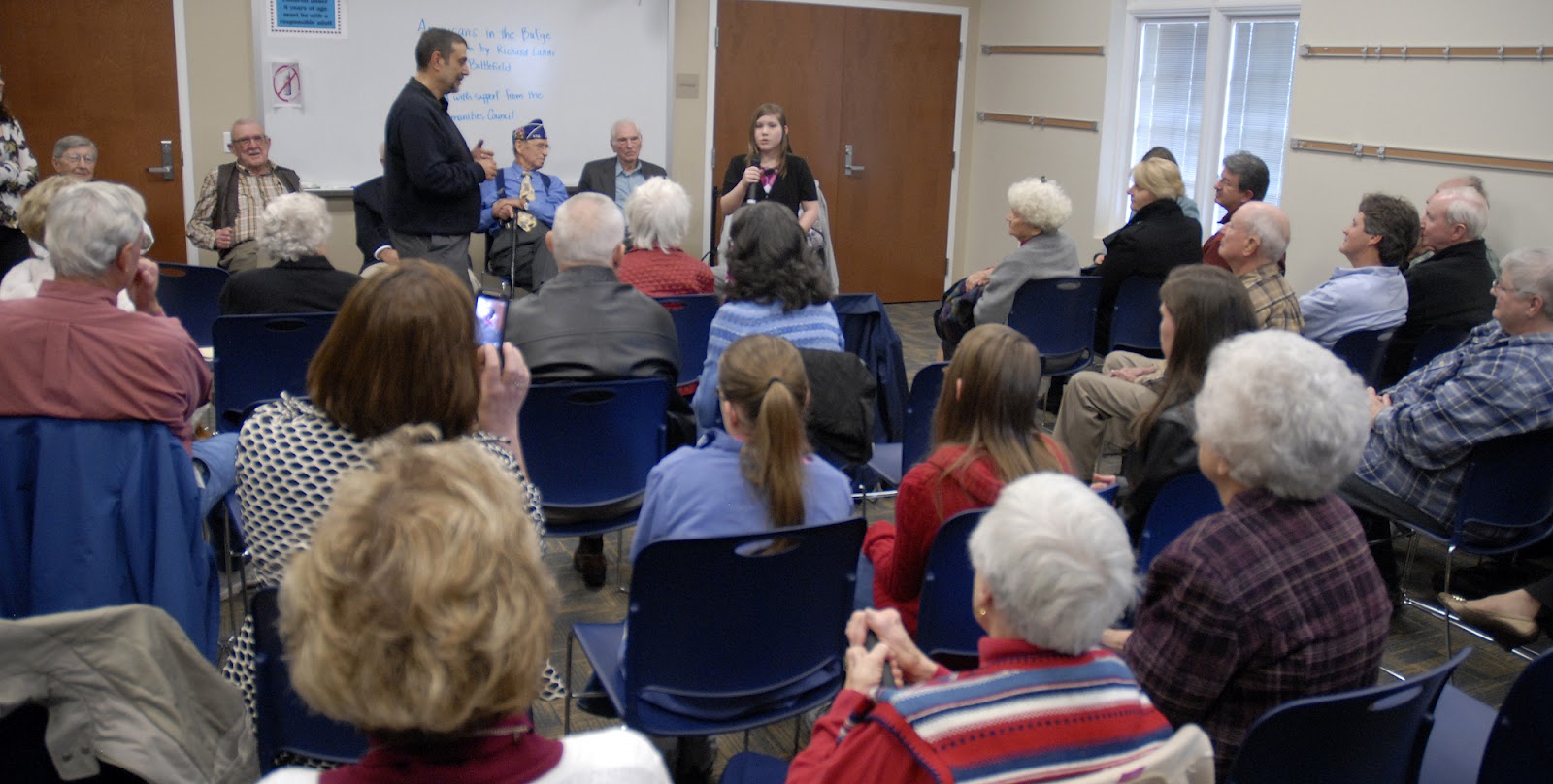
It has been an incredibly busy winter for the Livingbattlefield crew, as we’ve criss-crossed the Southeast, holding outreach screenings, mainly in libraries - the heart of most communities.  At each screening, we show one of the American Road to Victory films, and then invite local WWII veterans to share their personal war memories with audience members. The stories they've told have had audiences shivering with cold, tearing up with empathy and even laughing at the absurd things that can happen in the midst of war.

Richard introduces The Americans in the Bulge in Florence
The most popular film for this time of year has been the snow-filled Americans in the Bulge. Because the Bulge was so late in WWII, and because it was such a huge battle, every town we visited had veterans from the Bulge participate in the screenings. At the Florence County Library, fourteen WWII veterans attended the screening, nine of whom fought in the Bulge. One of the veterans had even served on a firing squad following the Nuremberg trials, something he talked about because a scene in the film featured actual footage from an American firing squad. He described his role, and said it was something he had to do, but an experience that was difficult to put out of his mind.

Sumter veteran speaks
The film triggered many memories. Veteran Jim Martin, featured in the film, said that Patton's Army didn't need to rescue the 101st Airborne, who were locked into trench warfare when Patton broke through with fresh troops. Martin said as long as the skies remained clear and they could get supplies, he and the other 101st paratroopers could have continued to fight on their own. Well, following the screening, another 101st veteran held a different view.

"I don't know about that guy, but I'll tell you right now, I was GLAD to see Patton!" 
The audience burst into laughter.

Stories of humanity were lovely to hear. One veteran talked about walking down a wooded path, exhausted and hungry. He saw a little German girl, all alone, holding a basket. The little girl ventured out to the path where he was walking and handed him a painted Easter egg.

veteran discusses segregation
We were reminded of the history that can still be touched when one veteran at the Orangeburg County library spoke of memories involving his great grandfather, who fought in the CIVIL war! He talked about this grandfather taking him to see the steam trains when he was a little boy. He also talked about what it was like to be a part of a segregated fighting unit in World War II. Richard, the film's director, then discussed how the Battle of the Bulge, in particular, was a turning point in segregation, and a chance for blacks and whites to fight side by side. The need was so great for soldiers at that point in the war,  blacks who might have only been allowed to drive trucks or to cook were handed rifles and told to fight.

Young lady thanks veterans for their sacrifices to help keep our country free
We are particularly excited when young people attend the screenings. Younger people seem to be deeply impacted by the bravery they witness during the films, and the opportunity to meet veterans who, when they were young, were committed to do anything and give everything for their country.

Young lady introduces her uncle to Richard, in front of her project
People often bring personal scrapbooks and letters to the screenings, and veterans might bring their medals, or objects they captured or found during the war. One young lady even brought her school project, which was about her uncle's experiences in WWII.  Following the Greenville County Library screening, local re-enactors attending the film allowed two young boys in the audience to hold actual WWII rifles.


All in all, the outreaches provided a wonderful opportunity for communities to explore the rich tapestry of their shared history. We received a lot of audience feedback, stressing the need to do these screenings throughout the country. But, it takes an enormous amount of time to set up good screenings, and, frankly, there is not much time left with our veterans to do them. So, in response, we are now hard at work on a screening packet for libraries. The packet will include instructions on how to find local veterans, customizable press releases and information on how to get the word out about a screening, poster art, a video introduction to the films and Q&A ideas to follow the films. We are offering this screening packet free to libraries that put The American Road to Victory trilogy into circulation.

We are seeking a corporate sponsor, to help get the films and screening packets into the hands of libraries throughout the US. Ideas are welcome! So, if you work with a corporation that might be interested in sponsoring community outreach screenings, or, if you work at a library that would like to hold an outreach, please contact Rachael in our office at 917-231-1231. Or, write to her at rachael at livingbattlefield dot org.